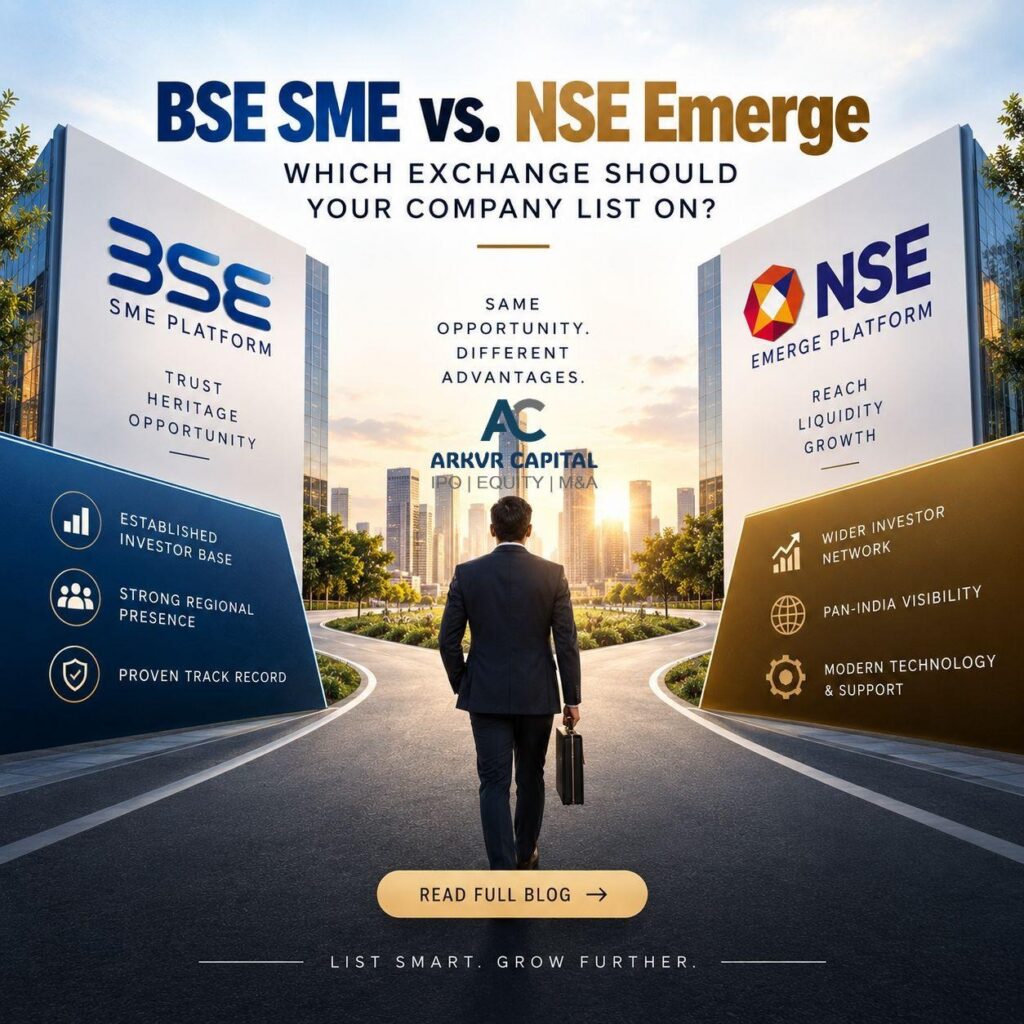
BSE SME vs NSE Emerge is the next big decision once your company clears SME IPO eligibility. Both exchanges operate under the same SEBI ICDR framework, and both offer broadly similar eligibility norms. But the practical experience of listing, trading, and staying visible to investors differs in ways that matter. This guide walks through what actually separates the two platforms, so you can choose with your merchant banker — not on reputation alone.
If you haven’t settled the larger question yet, our guide to SME IPO vs Mainboard IPO is the place to start.

The Basics
BSE SME launched in 2012 as India’s first dedicated SME exchange platform. NSE Emerge followed soon after. Today, both platforms have listed hundreds of companies between them. Both have well-established market making, Mainboard migration, and investor participation mechanisms. Neither platform is inherently better in a blanket sense. The right choice depends on your sector, investor base, geography, and your merchant banker’s network.
Listing Volume and Market Depth
Both exchanges have historically seen strong SME IPO activity. Volumes shift year to year based on market sentiment and each exchange’s regional outreach. Before choosing, ask your merchant banker for the current year’s data. Compare the number of SME IPOs, oversubscription trends, and post-listing price performance on each platform. This changes often enough that real-time data matters more than historical reputation alone.
Regional Presence and Investor Familiarity
BSE has traditionally had a strong base in Western India — Mumbai and Gujarat — given its history as India’s oldest exchange. NSE’s broader retail and institutional distribution network gives Emerge-listed stocks wider geographic exposure. If you’re headquartered in Chennai, Bangalore, or Mumbai, it’s worth assessing where your target investors — HNIs, family offices, sector-specific funds — are already active and trading.
Listing Costs and Fees
Both exchanges charge listing fees, annual fees, and processing charges. These are broadly comparable but not identical, and both revise their fee structures periodically. Get a current, itemized fee comparison from your merchant banker rather than relying on older published figures. Small differences in listing and annual fees can matter over a multi-year holding period, especially for smaller issue sizes.
Market Maker Ecosystem
Both platforms mandate a market maker to support liquidity. But the depth and competitiveness of that ecosystem can differ by platform and by sector. This includes how many market makers actively compete for SME stocks, and how tight their bid-ask spreads tend to be. A more liquid market-making environment means a better experience for your early investors trying to exit or add to positions.
Migration Pathway to Mainboard
Both BSE SME and NSE Emerge companies can migrate to their respective Mainboard platforms once they meet the financial and capital thresholds. Cross-migration — for example, from BSE SME to the NSE Mainboard — is also possible with the right compliance work. If migration is part of your multi-year plan, ask specifically about migration case studies and timelines on each platform in your sector.
Technology, Reporting, and Compliance Support
Both exchanges provide compliance dashboards, investor relations tools, and reporting systems for listed SME companies. But user experience, support responsiveness, and research coverage can vary. Talk to two or three companies already listed on each platform, ideally in your industry. Ask directly about their experience with compliance filings, exchange responsiveness, and investor relations support.
Sector Fit
Certain sectors have historically clustered more heavily on one platform or the other. This often comes down to which merchant bankers and market makers have built relationships and expertise there. If your sector — manufacturing, fintech, healthcare, consumer, agri-business — has a stronger track record on one exchange, that established investor familiarity can work in your favor at IPO time.
How to Decide: BSE SME vs NSE Emerge
In practice, the BSE SME vs NSE Emerge decision comes down to three questions. Which exchange does your merchant banker have the strongest relationship and track record with? Where does your target investor base already trade? And what does current comparative data show for oversubscription rates, listing-day performance, and post-listing liquidity in your sector on each platform? A good merchant banker brings you real data for both, not a one-line recommendation based on old habit.
How ARKVR Capital Advisory Helps
ARKVR Capital Advisory works with merchant banking partners on both BSE SME and NSE Emerge. We help founders make the BSE SME vs NSE Emerge call with current market data, not dated assumptions. That means factoring in your sector, investor base, and long-term Mainboard ambitions through our SME IPO Advisory practice.
If you’re weighing BSE SME vs NSE Emerge for an upcoming listing, talk to us before you commit to a platform. Get in touch with ARKVR Capital Advisory →
Frequently Asked Questions
Can a company list on both BSE SME and NSE Emerge simultaneously?
No. An SME IPO is executed on one platform at a time. Many companies do eventually get their shares additionally listed on the other exchange, once they meet specific requirements.
Does the exchange choice affect eligibility criteria?
The core SEBI ICDR eligibility framework is the same either way in the BSE SME vs NSE Emerge decision. Each exchange layers on some platform-specific requirements, such as minimum shareholders or specific disclosure formats. Always confirm the current exchange-specific checklist with your merchant banker.
Is one exchange cheaper than the other?
Fee structures are broadly comparable, and both are revised periodically. Get a current, like-for-like comparison rather than relying on historical figures.
Disclaimer: This article is for general informational purposes only. It does not constitute financial, legal, or investment advice. Exchange rules, fees, and eligibility norms are set by SEBI, BSE, and NSE, and are revised periodically. Always verify current details with your merchant banker and chartered accountant before choosing a listing platform.